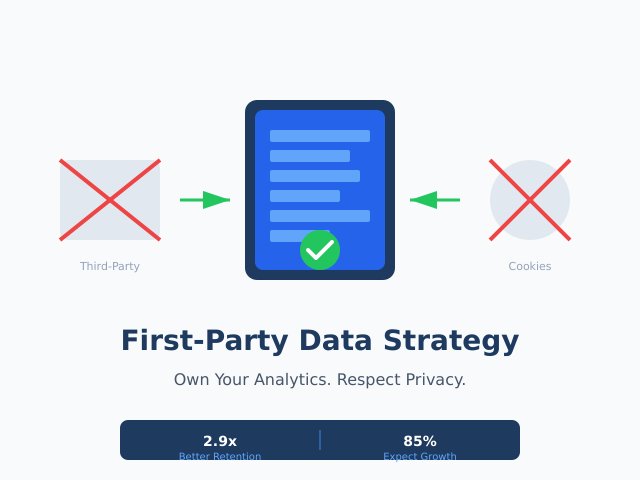
Third-party cookies are dying. Safari and Firefox already block them by default, and Chrome is giving users more control over tracking. If your analytics strategy still depends on following visitors across the web, you’re building on sand.
The good news? First-party data — information you collect directly from your own visitors — isn’t going anywhere. In fact, companies with mature first-party data strategies report 2.9x better customer retention and significantly lower acquisition costs. For small businesses and startups, this shift is actually an opportunity to compete on a more level playing field.
This guide walks you through building a first-party data strategy that respects privacy, complies with regulations like GDPR, and delivers actionable insights for growth.
What Is First-Party Data (And Why It Matters Now)
First-party data is any information you collect directly from people who interact with your business. This includes website behavior, purchase history, email engagement, form submissions, and customer feedback. Unlike third-party data purchased from external sources, first-party data belongs exclusively to you.
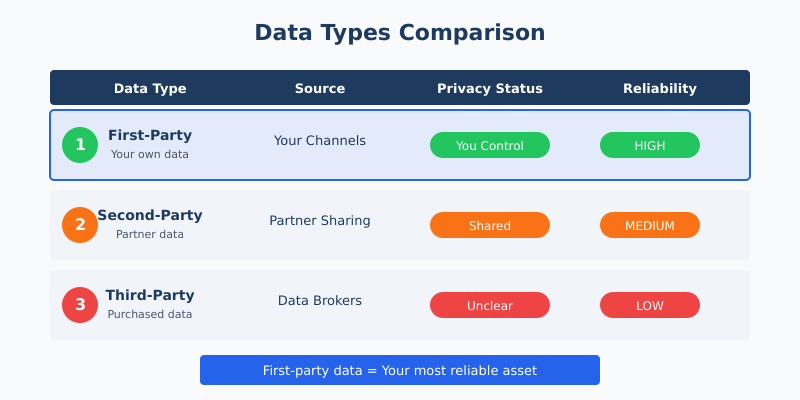
Here’s the critical distinction:
| Data Type | Source | Privacy Status | Reliability |
|---|---|---|---|
| First-party | Your own channels | You control consent | High — direct from user |
| Second-party | Partner sharing | Shared consent | Medium — indirect |
| Third-party | Data brokers | Often unclear | Low — aggregated, stale |
Why does this matter now? Nearly 40% of users browse with tracking prevention enabled. As a result, analytics tools that rely on cross-site tracking give you an incomplete picture. Meanwhile, privacy regulations continue to expand globally, making third-party data increasingly risky from a compliance standpoint.
First-party data sidesteps these problems entirely. When collected with proper consent, it’s fully compliant with GDPR, CCPA, and other privacy laws. More importantly, it’s accurate — because it comes directly from your visitors, not from some aggregated dataset of questionable origin.
The Core Principle: Own Your Data, Respect Your Users
A successful first-party data strategy rests on a simple exchange: you provide value, users share information willingly. This isn’t about tracking people without their knowledge. It’s about building relationships where data sharing benefits both parties.
In my experience working with small businesses, the companies that thrive with first-party data share three characteristics:
- Transparency — They tell visitors exactly what data they collect and why
- Value exchange — They offer something meaningful in return (better experience, relevant content, personalized service)
- Data minimization — They only collect what they actually need
This approach isn’t just ethical — it’s practical. Users who trust you are more likely to share accurate information. And accurate data leads to better decisions.
Building Your First-Party Data Strategy: A Practical Framework
Let’s break this down into actionable steps. Whether you’re a startup with five employees or a growing business with a small marketing team, this framework scales to your needs.
Step 1: Audit Your Current Data Collection
Before building something new, understand what you already have. Most businesses collect more first-party data than they realize — they just don’t use it effectively.
Start by listing every touchpoint where you interact with customers:
- Website visits and behavior
- Email subscriptions and engagement
- Purchase transactions
- Customer support interactions
- Social media engagement
- Survey responses and feedback forms
For each touchpoint, ask: What data do we collect? Where is it stored? How often do we actually use it? You’ll likely discover valuable data sitting unused in various systems.
Step 2: Define What You Actually Need
More data isn’t better data. In fact, collecting information you don’t use creates liability without benefit. Instead, work backward from your business questions.
For example, if you want to understand which content drives conversions, you need:
- Page view data tied to sessions
- Conversion events (purchases, signups, etc.)
- Traffic source attribution
You probably don’t need detailed demographic profiles, browsing history across sessions, or behavioral predictions. Keep it simple. As one marketing director told me, “We cut our data collection in half and our insights doubled — because we finally had time to analyze what we kept.”
Step 3: Implement Privacy-First Collection
How you collect data matters as much as what you collect. Here’s the hierarchy of privacy-compliant analytics approaches:
| Method | Privacy Level | Data Richness | Best For |
|---|---|---|---|
| Aggregated analytics | Highest | Basic | Traffic trends, content performance |
| Cookieless tracking | High | Moderate | Session behavior without identifiers |
| First-party cookies | Medium | Good | Return visitor analysis |
| Authenticated data | Varies | Rich | Logged-in user journeys |
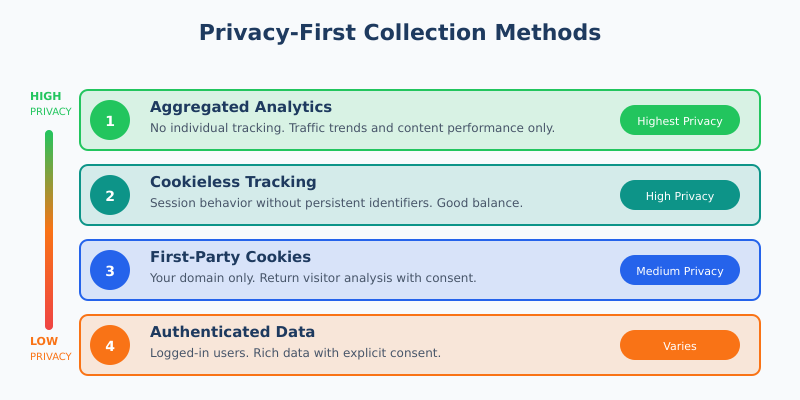
For most small businesses, a combination of cookieless analytics for general traffic and first-party cookies for deeper analysis works well. The key is being transparent about each method and giving users control.
Important: Whatever approach you choose, make sure your privacy policy accurately describes your data practices. Saying you don’t use cookies while running cookie-based tracking is a compliance violation waiting to happen.
Step 4: Create Value Exchanges
The richest first-party data comes from users who actively share information. However, they won’t do this for nothing. You need to offer genuine value in return.
Effective value exchanges for small businesses:
- Email newsletters — Offer exclusive content, early access, or discounts in exchange for email signup
- Account creation — Provide saved preferences, order history, or personalized recommendations
- Surveys and feedback — Offer entry into a prize drawing or a discount code
- Gated content — Share detailed guides, templates, or tools in exchange for contact information
The pattern here is clear: give something valuable, ask for specific information, and explain how you’ll use it. This builds trust while growing your first-party data asset.
Step 5: Unify Your Data
Scattered data is nearly useless. If your email engagement lives in one system, website analytics in another, and purchase data in a third, you can’t see the complete customer journey.
For small businesses, you don’t need an enterprise customer data platform. Start with these practical steps:
- Choose a primary identifier — Email address works for most businesses
- Export and merge regularly — Even a monthly spreadsheet merge beats siloed data
- Use integrations — Most tools offer native connections to share data
As you grow, consider dedicated tools for data unification. However, don’t let perfect be the enemy of good. A simple merged view updated monthly beats a sophisticated system you never implement.
First-Party Data Strategy for Different Business Types
The principles are universal, but implementation varies. Here’s how to adapt based on your business model.
For E-commerce
E-commerce businesses have a natural advantage: transactions generate rich first-party data automatically. Your strategy should focus on:
- Purchase behavior analysis — What do customers buy together? What’s the typical time between purchases?
- Browse-to-buy patterns — Which product pages lead to conversions? Where do visitors abandon?
- Customer lifetime value — Segment by value to focus retention efforts
The key metrics for measuring promotion success become much more accurate when built on first-party transaction data rather than cookie-based attribution.
For Service Businesses
Service businesses often have longer sales cycles and fewer transactions. Focus on:
- Lead source tracking — Which channels bring qualified leads?
- Content engagement — What topics resonate with potential clients?
- Consultation requests — What pages do visitors view before reaching out?
Since you have fewer data points, each one matters more. Implement event tracking for meaningful actions like form starts, service page views, and pricing page engagement.
For Content Publishers
Publishers live and die by engagement metrics. Your first-party strategy should capture:
- Reading depth — How far do visitors scroll? Do they finish articles?
- Return frequency — How often do readers come back?
- Newsletter engagement — Opens, clicks, and conversions
Understanding unique visitors versus returning readers becomes essential for content strategy — and first-party data gives you this without invasive tracking.
Common Mistakes to Avoid
In helping businesses transition to first-party data strategies, I’ve seen the same mistakes repeatedly. Learn from others’ errors.
Mistake 1: Collecting Everything “Just in Case”
More data creates more liability, more storage costs, and more noise. If you can’t articulate why you need a data point, don’t collect it. You can always add collection later; removing data you shouldn’t have collected is much harder.
Mistake 2: Ignoring Data Quality
First-party data is only valuable if it’s accurate. Implement validation on form fields. Clean your email lists regularly. Remove duplicate records. A smaller, accurate dataset beats a large, messy one every time.
Mistake 3: Forgetting About Consent
Just because data is first-party doesn’t mean consent is automatic. You still need to:
- Explain what you collect in plain language
- Provide opt-out mechanisms
- Honor data deletion requests
- Document consent for compliance
Review the global privacy landscape to ensure your practices meet requirements in all jurisdictions where you operate.
Mistake 4: Not Acting on Insights
Data without action is just storage. Every piece of information you collect should connect to a potential decision. If your weekly analytics review never leads to changes, you’re either collecting the wrong data or not looking at it correctly.
Measuring Success: KPIs for Your First-Party Data Strategy
How do you know if your strategy is working? Track these metrics:
| Metric | What It Measures | Target |
|---|---|---|
| Known visitor rate | % of visitors with email or account | 15-30% for most businesses |
| Data completeness | % of profiles with key fields filled | >80% |
| Consent rate | % of visitors who accept data collection | 60-80% with good UX |
| Data-driven decisions | Actions taken based on first-party data | Weekly minimum |
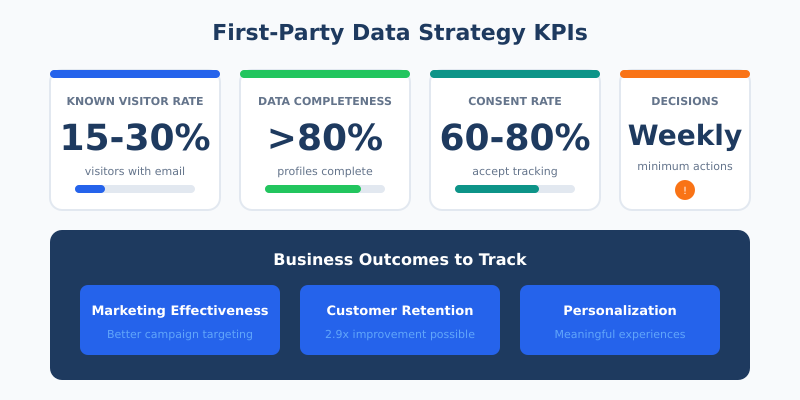
Beyond these tactical metrics, look at business outcomes. Are your marketing campaigns more effective? Is customer retention improving? Can you personalize experiences in ways that matter? These outcomes are the ultimate measure of success.
The Third-Party Cookies Alternative: What Comes Next
While first-party data forms your foundation, the industry is developing additional privacy-preserving approaches:
- Contextual targeting — Placing ads based on page content rather than user behavior
- Cohort-based analysis — Grouping users by behavior without individual tracking
- Server-side tracking — Processing data on your servers rather than in browsers
- Privacy-preserving attribution — Measuring conversions without exposing individual journeys
These approaches complement first-party data rather than replacing it. Your owned data remains the most reliable source; these methods help fill gaps where first-party collection isn’t possible.
For businesses exploring AI and machine learning in analytics, first-party data provides the clean, consented training data that makes models actually useful — and legally defensible.
Continue Learning
Explore more about building privacy-respecting analytics:
- Beyond Pageviews: Advanced Metrics That Predict Business Success — Move past vanity metrics to measurements that matter
- The Hidden Cost of Spam Traffic — Keep your first-party data clean from bot contamination
- CTA Buttons: How to Track Their Performance — Implement event tracking for meaningful actions
Bottom Line
The death of third-party cookies isn’t a crisis — it’s a correction. For years, the industry built on borrowed data and questionable consent. That era is ending.
A first-party data strategy puts you back in control. You own your data. You know where it came from. You can prove consent. And most importantly, you can trust what it tells you.
Start simple: audit what you have, define what you need, implement transparent collection, and actually use what you gather. The businesses that thrive in the privacy-first future won’t be those with the most data — they’ll be those who use their data most wisely.
Your visitors are willing to share information with you. Earn that trust, and you’ll have all the data you need to grow.