New vs Returning Visitors: The Signal That Predicts Your Future
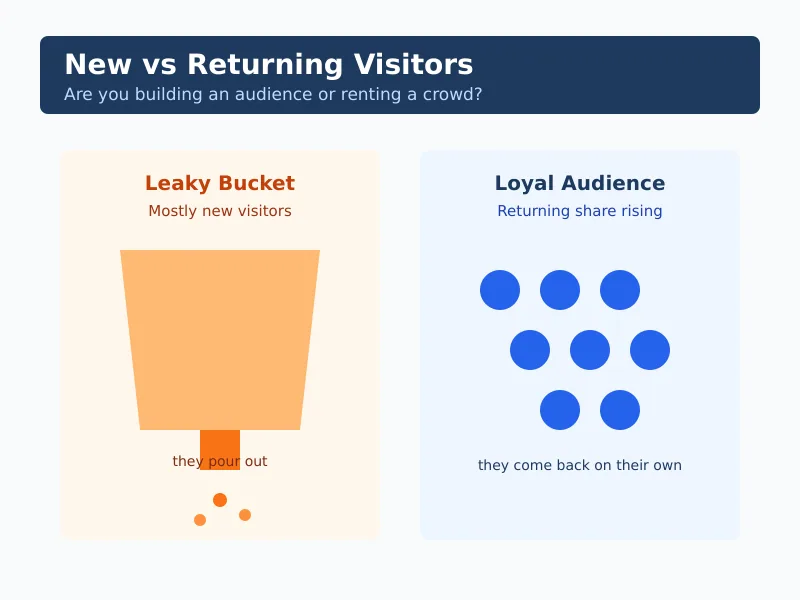
Two businesses can have the same traffic and opposite futures. One fills a leaky bucket — pouring in new visitors who never come back. The other builds an audience that returns on its own. The split between new vs returning visitors is the clearest early signal of which business you’re running, long before revenue confirms it.
In my experience, founders obsess over getting more visitors and ignore whether anyone comes back. That’s backwards. Acquisition is expensive and endless; loyalty compounds. This guide explains what the new-versus-returning split actually means, what healthy ratios look like, and how to read the signal without tracking individuals.
What “New vs Returning” Really Measures
A new visitor is someone visiting for the first time in the measured window. A returning visitor has been here before. Most analytics determine this with a first-party signal stored on the device — no name, no profile, just a “we’ve seen this browser” flag. That’s an important distinction: you’re measuring behaviour, not identity.
The split tells you two different things at once. New visitors measure your reach — how well you attract attention. Returning visitors measure your retention — how well you keep it. A healthy site needs both, but the balance depends entirely on what you’re building.
Related: tracking unique visitors explains the counting layer beneath this split.
What a Healthy Ratio Looks Like
There’s no universal “good” ratio — context decides. A news site lives on returning readers; a one-off service page lives on new ones. Here’s a rough map of what to expect by business type.
| Business type | Typical returning share | What it signals |
|---|---|---|
| Content / media site | 40–60% | Loyalty is the whole model |
| SaaS / web app | 50–70% | Returning = active usage |
| Ecommerce store | 25–40% | Repeat buyers drive margin |
| Lead-gen / local service | 10–25% | Mostly one-time intent |
Use these as a sanity check, not a target. The real signal is the trend. A returning share that’s slowly climbing means your audience is sticking. One that’s sliding means you’re refilling a leaky bucket — and that’s expensive.
Reading the Four Quadrants
The most useful way to read this split is to combine it with one other number: are visits going up or down? That gives you four situations, each pointing to a different action.
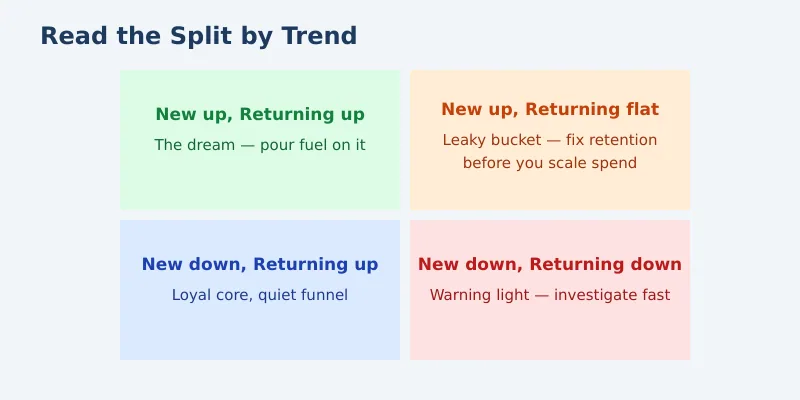
- New up, returning up: the dream. You’re acquiring and keeping. Pour fuel on it.
- New up, returning flat or down: a leaky bucket. You’re buying attention nobody keeps. Fix retention before scaling spend.
- New down, returning up: a loyal core but a quiet top of funnel. Your audience loves you; not enough people are finding you.
- New down, returning down: the warning light. Something broke — a channel, a product, a trust signal. Investigate fast.
For instance, a store that “doubled traffic” but saw returning visitors flatten didn’t grow — it rented a crowd. Once the ad spend stopped, so did the traffic. By contrast, a slow rise in returning share is the quiet sound of a business getting durable.
New visitors are rented. Returning visitors are owned. Build toward ownership.
How to Improve Your Returning Share
If your returning share is too low for your business type, here’s where to start — in rough order of effort to payoff.
- Give people a reason to return. Fresh content, a useful tool, a reason to check back.
- Build an owned channel. Email or a subscription turns a one-time visit into a relationship.
- Fix the second-visit experience. Returning users expect to pick up where they left off.
- Reduce friction at the door. Slow pages and rough mobile flows kill the second visit silently.
- Track the trend monthly. Returning share is a slow metric; judge it over quarters, not days.
That second point does the heavy lifting. An owned channel is the only reliable way to bring people back on purpose rather than hoping they remember you. It also keeps you off the treadmill of paying for the same audience twice.
Common Mistakes to Avoid
- Treating one ratio as universal. Context decides what’s healthy.
- Celebrating new-visitor spikes while returning share quietly falls.
- Judging the split daily. It’s a slow trend; short windows are noise.
- Confusing returning with engaged. A return visit isn’t automatically a good one — pair it with engaged time.
- Reaching for invasive tracking. A first-party “seen before” flag is enough; you don’t need a profile.
That last point keeps you on the right side of privacy. You can measure loyalty perfectly well with a single first-party signal, which respects both the spirit and the letter of the GDPR’s data-minimisation principle. The UK ICO offers practical guidance on doing this lawfully.
Continue Learning
Explore more about reading audience behaviour:
- Web Analytics Segmentation — split new vs returning by device and channel for sharper insight.
- Beyond Pageviews: Advanced Metrics — retention as a growth predictor.
- Exit Rate: Why Visitors Leave — what pushes returning visitors away.
Bottom Line
The new vs returning visitors split is your earliest read on whether you’re building an audience or renting a crowd. Judge it by business type and trend, combine it with traffic direction to know what to do, and grow your returning share with owned channels and a better second visit. Do it all with first-party signals — no profiles, no invasive tracking.
Acquisition gets you noticed. Retention keeps you alive.